


Authors Note
When someone asks if I have any hobbies, this is it. It might seem odd to “ponder the universe” as a hobby.
But I’d argue it’s actually a well-known fact that the best way to spend ANY amount of time on ANY amount of drugs is to sit back and go “YO BUT what IF LIKE…”
My background is in Software, so I have no business writing about spacetime.
But if the music industry can tolerate Rick Rubin, then maybe I can share “taste” for how the universe ought to work.
I am sure the odds of getting committed rise significantly the moment anyone starts saying “I have a theory of the universe.”
So to get ahead of whoever it was that plotted to get Kanye; Here’s what this actually is.
This is my best guess on how it should all work. The odds I am right are about as close to zero as something can be. But if even one concept inspires a thought in someone more capable I’d consider that a win.
Cheers,
A Very Serious Person (Greg)
TL;DR:
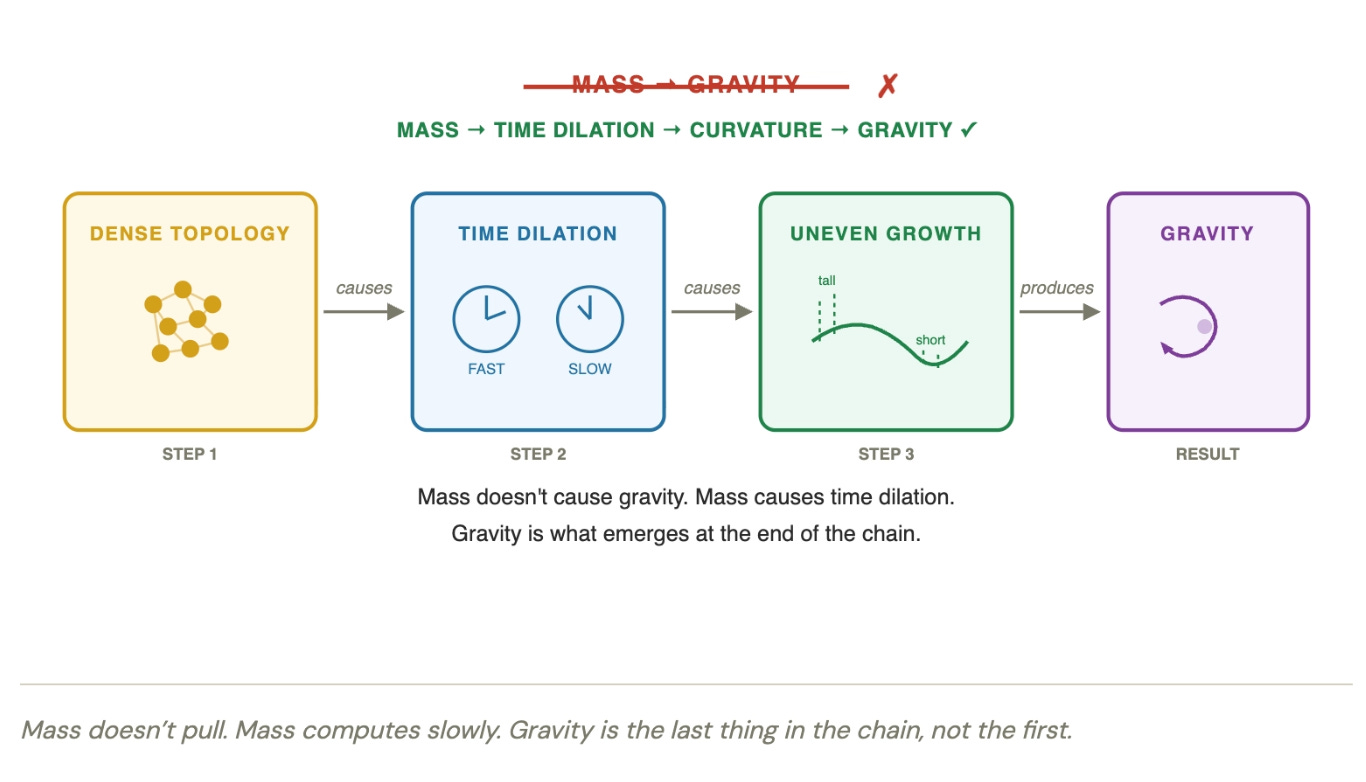
Mass is not warping the fabric of spacetime. The universe is a graph of events, and regions with mass grow slower. This difference in growth rates leads to uneven curvature in spacetime and gravity emerges.
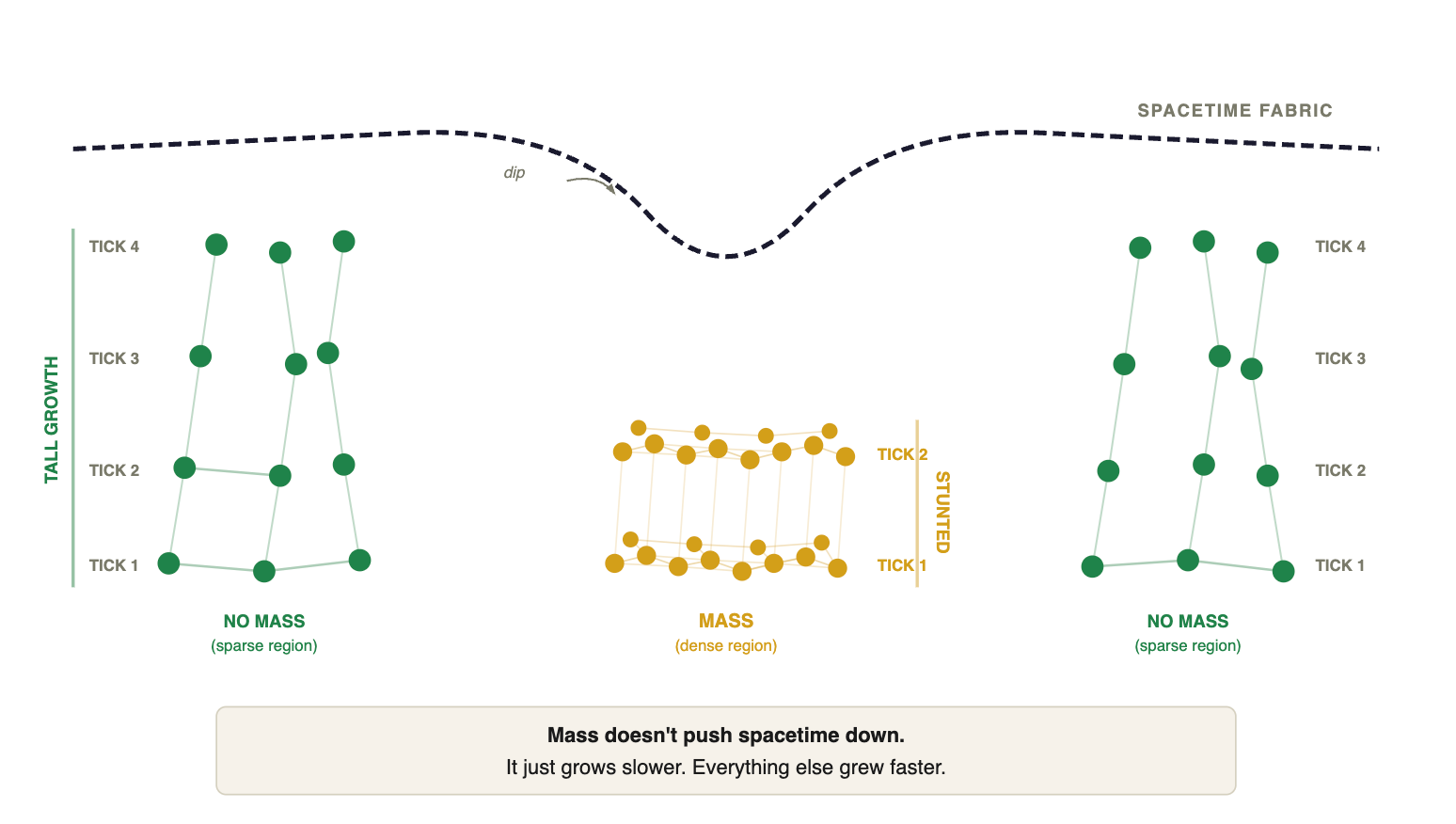
This is why you can not shield gravity like other forces; Gravity is a consequence of time dilation and the tax you pay in order to arrive at the “next now”.
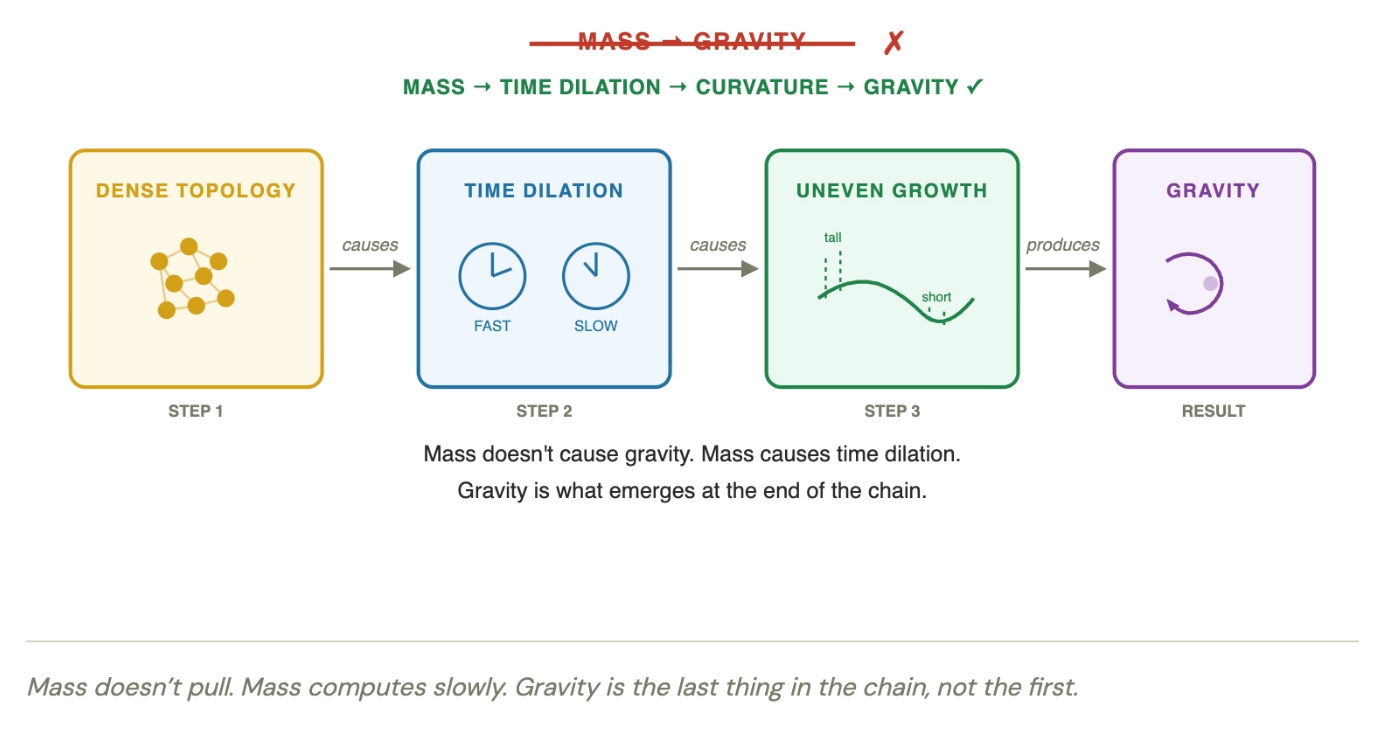
This framework draws heavily from causal set theory and Wolfram’s physics project, but diverges on the mechanism of curvature.
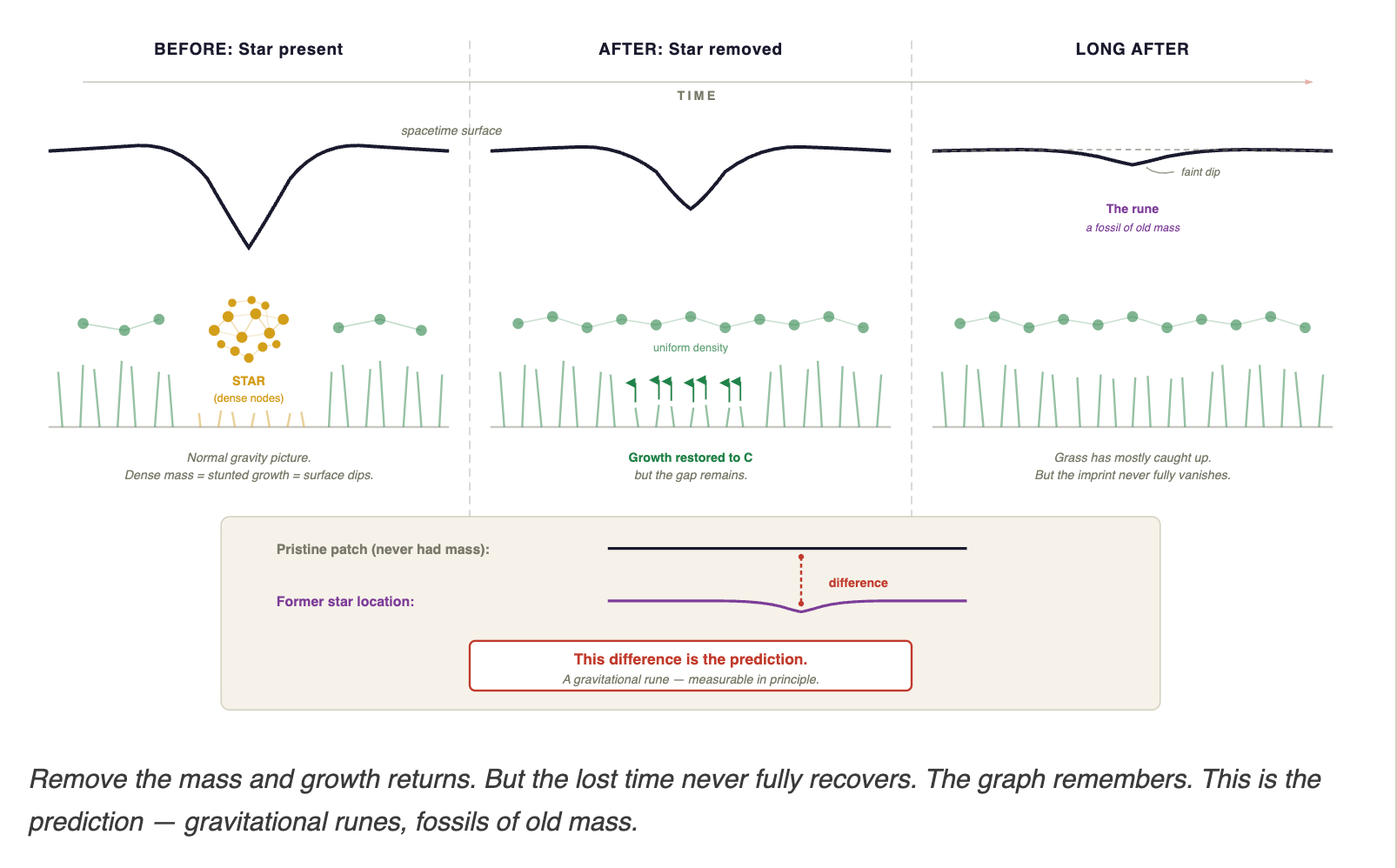
The novel claim is the prediction of Gravitational Runes. Removing mass from a region restores its growth rate, but it can never catch up to space that was always empty. GR predicts spacetime snaps back to flat. We predict a permanent geometric deficit, a fossil in the graph
Chapter 1: A Duck in a Tub
Imagine a rubber duck floating in a bathtub.
Water pours in, time passes, and the duck rises with the water level. From the rubber ducks perspective, reality — everything it experiences — is the surface of the water. But its experience is actually composed of the billions of H₂O molecules it floats on.
Our universe is the same, you exist on a massive ocean of events that all lead you to your “here” and “now”. Trace any moment of your life and what you will find is there is always a sequence of events that brought you to where you are now. This idea of “here” and “now”, has another name, “space” and “time”, or Spacetime.
You are floating on an ocean of past events that all brought you to your “here”, and “now”.
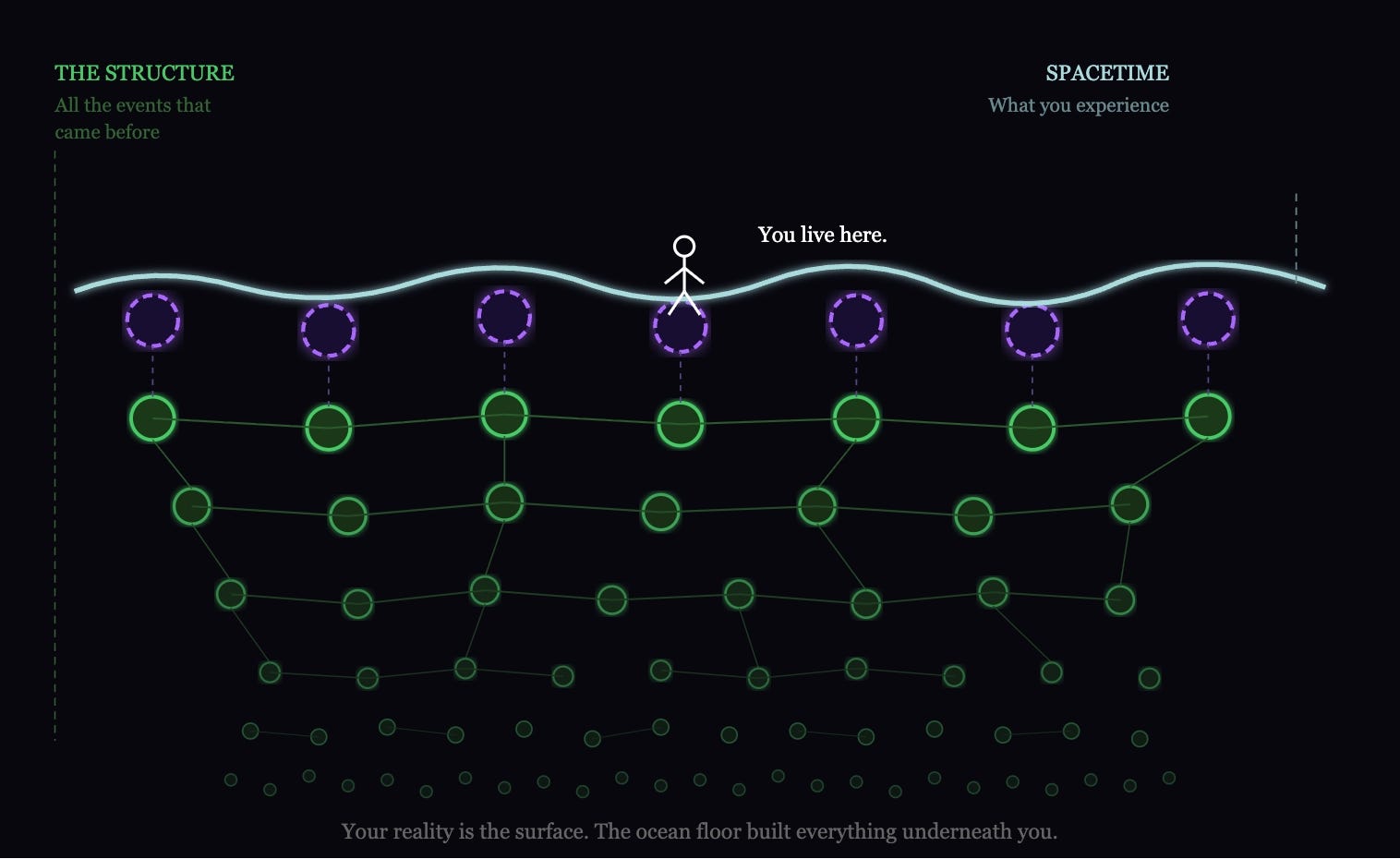
So what is this “ocean of events”? We are going to refer to them as the Event Graph.
Chapter 2: The Event Graph
So it’s not water you’re floating on, but a graph.
A graph of every event that has ever happened, going all the way back to the Big Bang. This idea is a real branch of physics, this framework draws heavily from causal set theory and Wolfram’s project.
Each dot in the graph is an event. Events themselves hold no properties. What matters is their position in the graph and which other events they’re connected to.
Your family tree works the same way. If we want to know whether you’re a parent, we don’t need a label. We just check if there are people joined below you. Position gives you the value.
Operations in the graph are stored as edges/connections between events. These operations are computed and generate the “next now”.
Here's a concrete example. Take the equation 3 × 2 + 2. If we treat the numbers as events and the operations as edges, we get a graph:
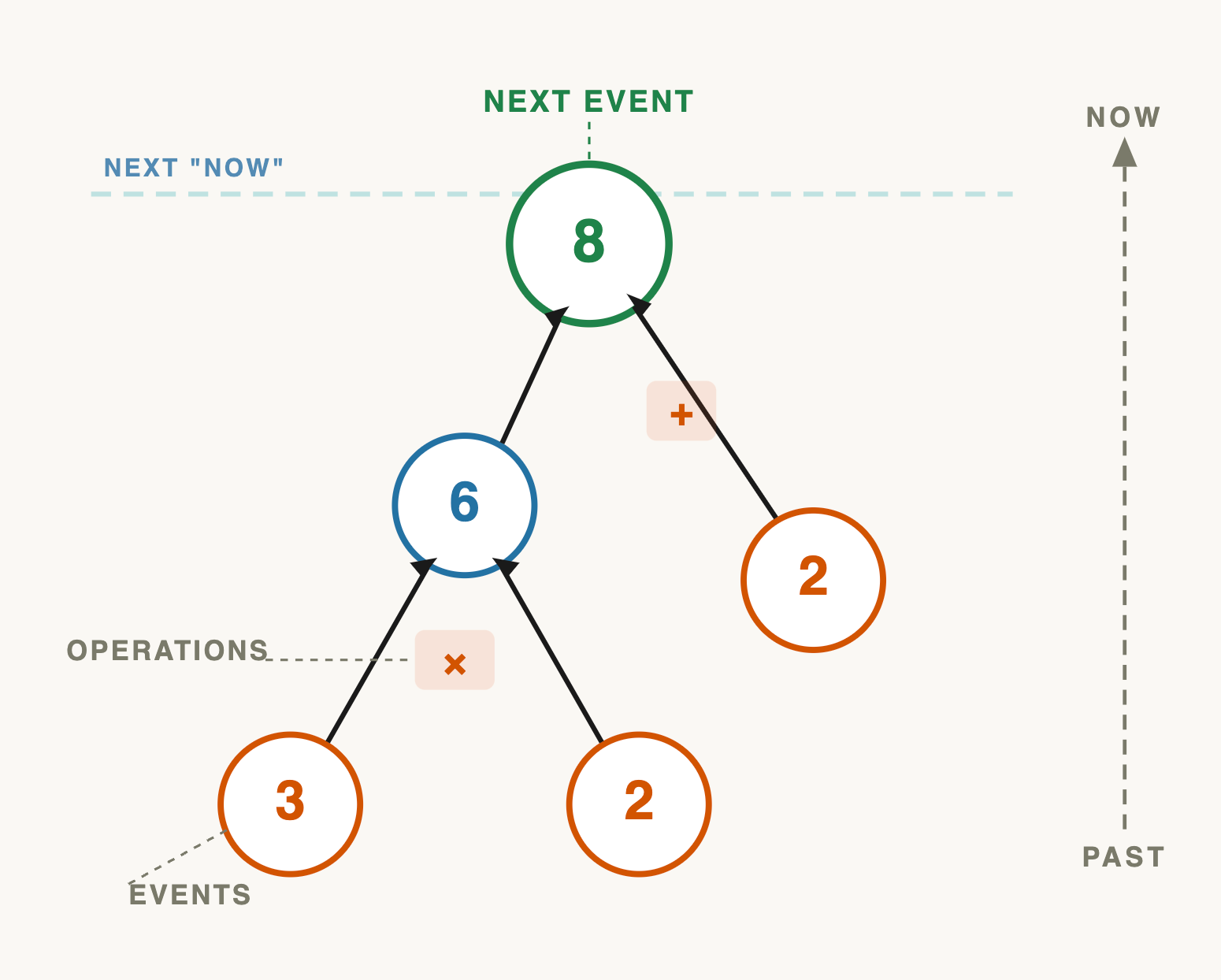
Time is the graph getting taller. Events feed forward through operations to produce new events.
Now here’s the critical property: the graph has a speed limit.
Our universe, has a speed limit too, the speed of light (C).
In our model, this has nothing to do with light. This is the maximum rate that change can propagate through the graph, and as a consequence in our universe as well.
If I asked you 1 + 1, you might answer instantly. However, if I asked you 7,732,734 % 837 × 435 + 83⁹, it might take longer. The graph is the same, denser operations take longer to resolve. The speed of light is our thinking speed.
A star has more events in play than an empty patch of space. A black hole has more going on than a star. If the graph has a fixed processing speed and dense regions have more to process, then dense regions take longer to reach their next “now.”
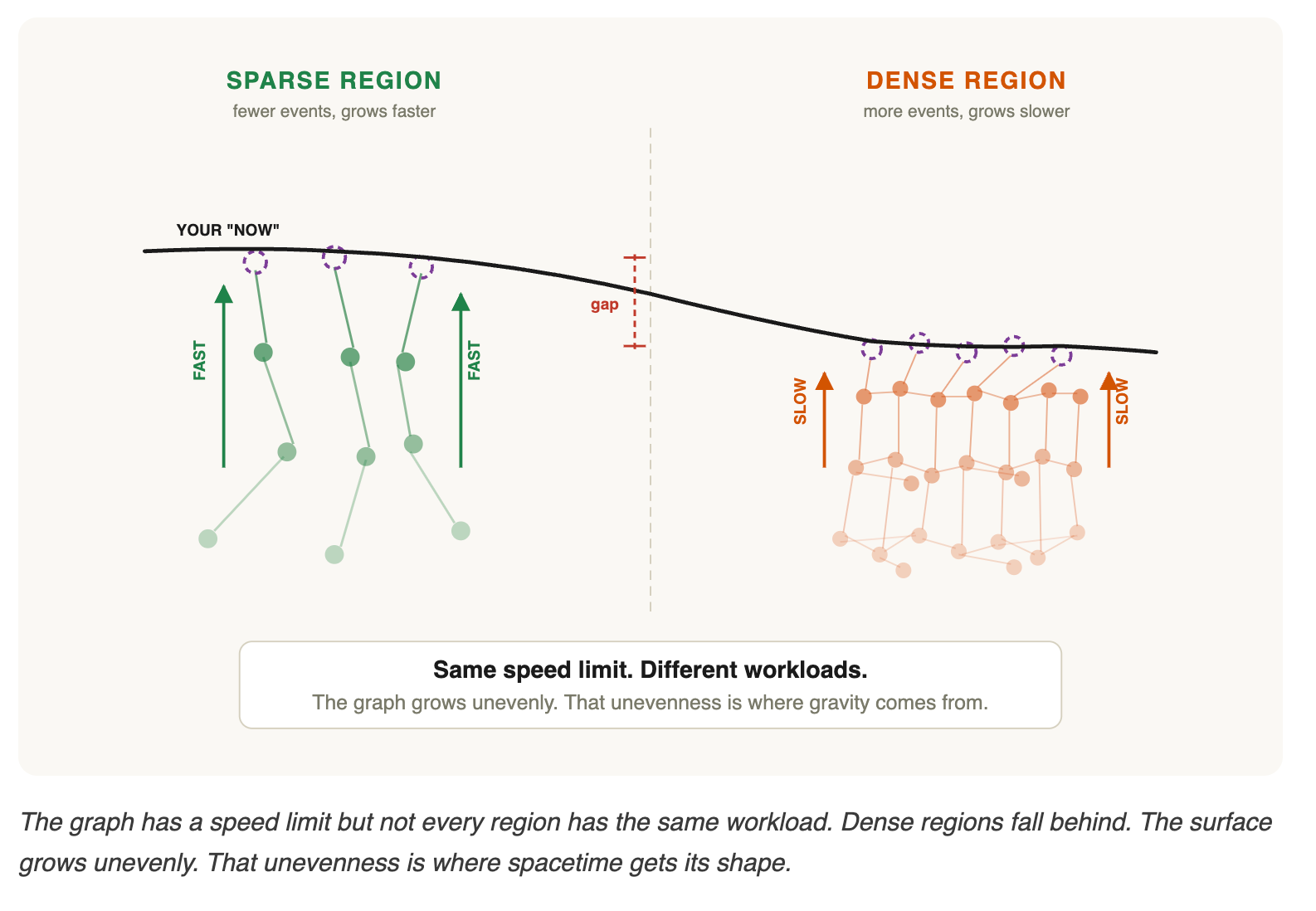
This is where time dilation emerges. Time slows near massive objects because those regions of the graph are computationally heavier. Faster velocity also slows time because motion means more edge writes and thus more operations.
Chapter 3: Spacetime
Open up any physics textbook on spacetime and you will see a picture of a bowling ball on a trampoline. Mass warps the fabric of spacetime, and this curvature gives us gravity.
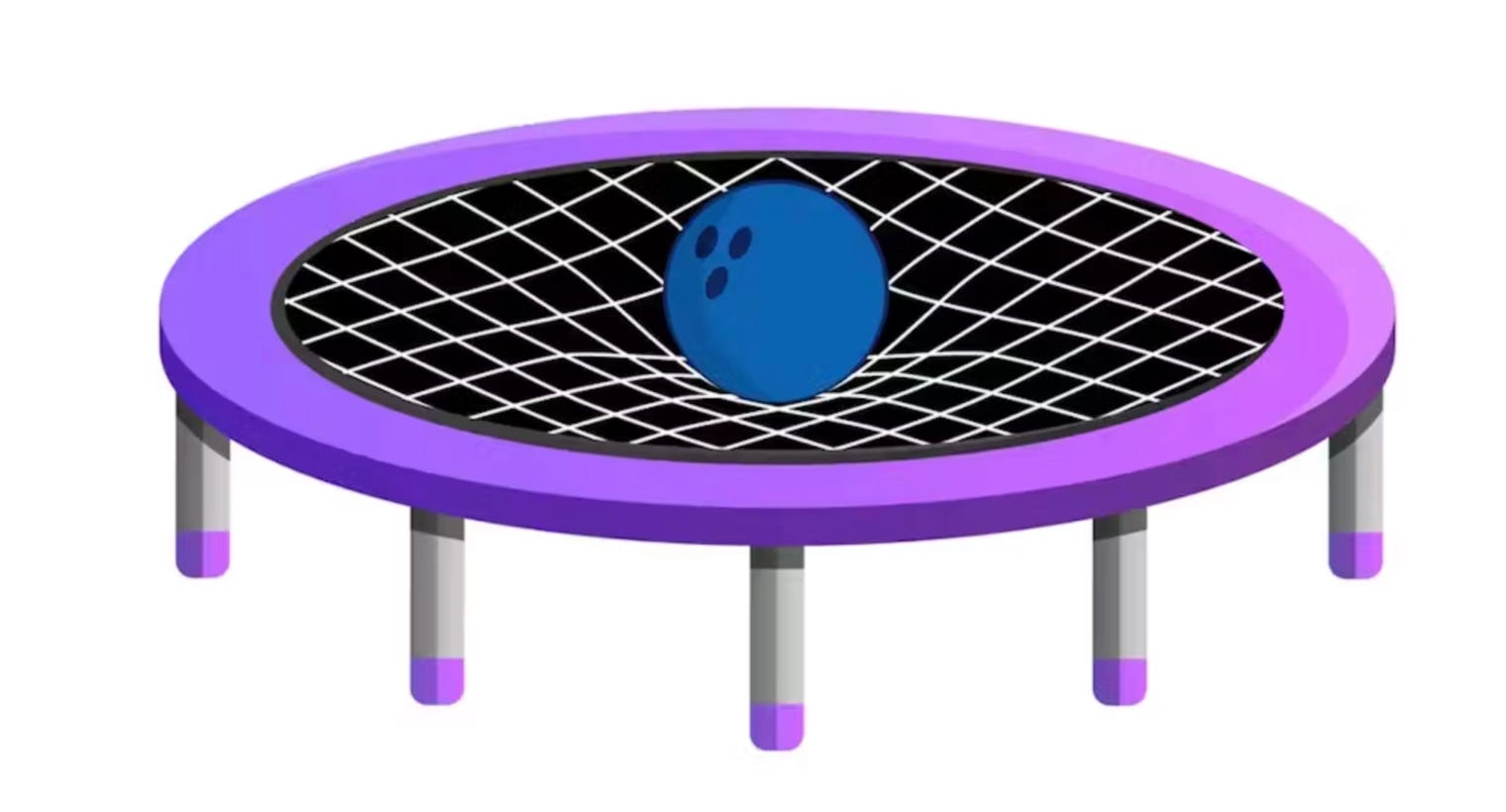
In our model, this is inaccurate. The end result is correct, but the mechanism for how mass warps spacetime is wrong.
We said spacetime is the surface of our event graph, and our graph is not growing evenly. Dense regions have more to process, so they grow slower. Sparse regions race ahead.
So here’s our claim: Mass does not warp spacetime like a bowling ball on a trampoline. Mass causes regions of the graph to grow slower than the regions around them.
A better analogy would be to imagine a meadow with a rock in it, the grass around the meadow grows freely, but grass under the rock grows more slowly. The end result is it might look that the rock warped the rest of the grass, but we are saying the curvature is the result in a difference in growth rates NOT a warping of fabric.
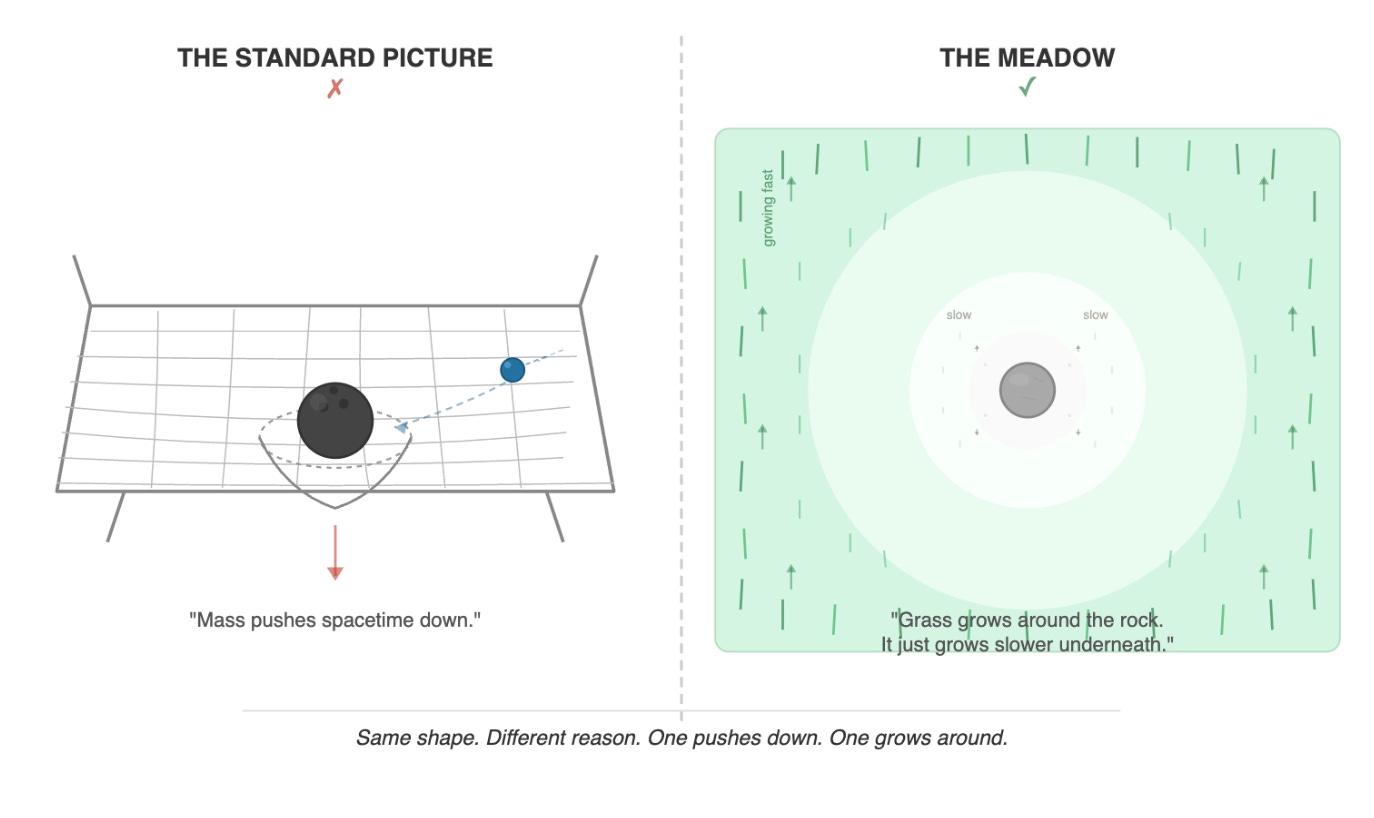
Same shape. Different mechanism. And the mechanism matters, because it changes what spacetime is. It’s not a fabric being deformed. It’s a graph being outpaced.
This is the core claim of this entire framework. General Relativity describes the shape of spacetime with extraordinary precision. It tells you what mass does to geometry. But it doesn’t tell you why.
We’re proposing one: mass is computationally dense, the graph has a processing speed limit, and mass regions lag behind their surroundings. The curvature is real. The shape is the same. But now there’s a reason for it.
But why would mass slow the growth of the graph? What is mass, actually, in a universe made of events?
Chapter 4: Mass
So what is mass in a universe made of events?
At the graph level, there are no objects, no particles, no photons. There are only events and the operations that connect them. Mass, objects, particles, these are all the result of stable configurations within the graph. A collection of events that join together into a specific topology, and whose shape repeats into the next “now.”
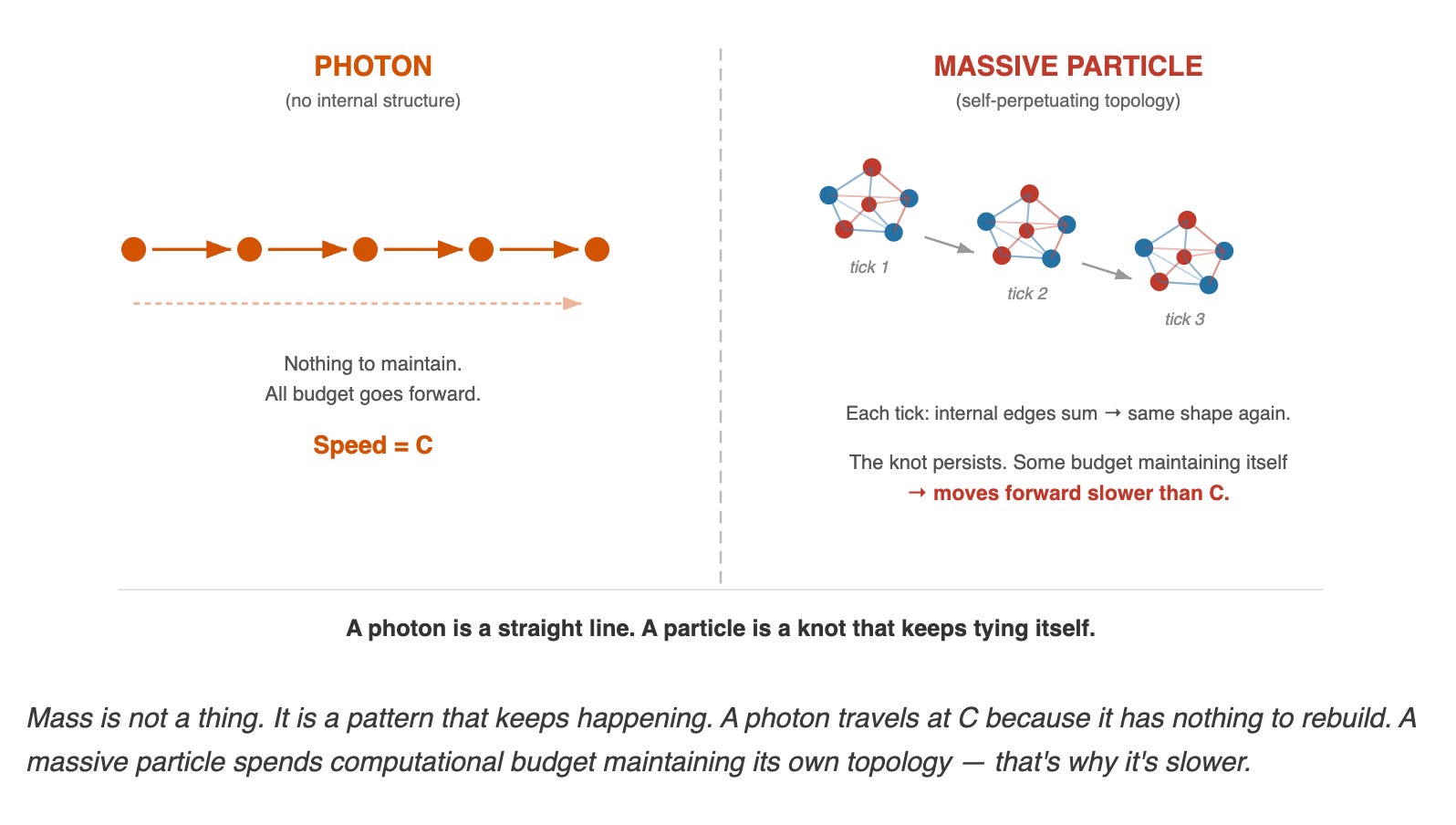
When the graph builds the next layer of reality, moving from current now to future now, it sums all the operations in a region. For mass, when you sum everything together, it generates the same shape again.
Mass is a self-perpetuating topology within the event graph.
To be honest this is a bit of a head fuck, but stay with me. You think of mass as something that just is. But really it’s something that existed, and then the bookkeeping decided it should exist again.
Imagine your boss pays you $1,000 (event 1). Your landlord charges you $1,000 (event 2). Sum them together and you were poor then, you’re poor now. If those events repeat in the next now, you have a self-perpetuating topology of poverty. You are not just poor, you are forever poor.
Regions of the graph with simple structures process in a single tick and grow at the speed of light. Regions with dense, self-perpetuating topologies grow slower, giving rise to time dilation, which gives rise to curvature, and finally gravity emerges.
Chapter 5: Gravitational Runes
So what would happen if you delete the sun?
In the standard model, mass warps spacetime like a bowling ball on a trampoline. Remove the ball, the trampoline snaps back. Spacetime restores to flat.
In our model, something different happens. The sun was a dense region of the graph, which had a slower growth rate. Remove it, and the growth rate in that region is restored. The grass starts growing at full speed again.
Compared to Earth, the region with the sun will eventually “catch up”, and surpass earth. But if you compared it to a region of space that never had mass, and was always growing at rate C, it can never catch up. There will always be a deficit. The region of the sun will always be behind the region of space that never had mass in the first place.
We call this a gravitational rune: a permanent geometric fossil left in the graph by former mass.
This is not the same as the gravitational wave memory effect. Gravitational memory is a residual distortion left by the passage of violent energy, merging black holes, colliding neutron stars. A gravitational rune is quieter. It’s the deficit left by the ordinary presence of mass over time. No cataclysm required. Just a region that fell behind and never caught back up.
This is a prediction our model makes that GR does not. If you could find a pristine patch of space that never contained mass and compare its local geometry to a region that used to, and if there’s a measurable difference, that would be evidence of a gravitational rune.
Now, the math may not work out. You can’t just delete a planet without energy radiating into surrounding regions, which would impact their growth rates. Whether this deficit is measurable is an open question. If anyone smart wants to chime in here please do.
Part 2: The Quantum World
No crackpot theory of everything would be complete unless we also tried to tackle the quantum world applying the same principles.
For that there will be a Part 2 post.